
Carroll County Criminal Court Cases
Carroll County criminal court cases divide by court authority, not just by the severity written beside a charge. General Sessions hears misdemeanors within its jurisdiction and conducts preliminary work in felony cases. That lower-court record may hold the complaint, initial appearance, bond event, hearing settings, and the result of a preliminary hearing. If a grand jury returns an indictment, the felony case proceeds in Circuit/Criminal Court. Its file then tracks arraignment, motions, pleas, trial activity, judgment, sentence, and possible appeal.
Municipal courts are a third lane. Huntingdon Municipal Court, for example, keeps authorized traffic and ordinance matters rather than handing every citation to the county criminal clerks. A person who searches only Circuit records can miss the General Sessions beginning of a felony, while a county search may not locate a city citation at all. The case number, filing court, and charge level together show which Carroll County office should hold the court record.
Carroll County Criminal Court Roles
The two criminal clerk lines make the local split practical. Circuit Criminal can be reached at 731-986-1927, and General Sessions Criminal at 731-986-1926. The main Circuit Court Clerk line is 731-986-1932. All three routes lead back to the Carroll County Courthouse at 99 Court Square, Suite 103, Huntingdon, Tennessee 38344. Ask the clerk to confirm the court level before requesting a pleading or certified judgment, especially when a felony began in General Sessions and later received a Circuit number. The official Carroll County court page identifies the court officials, clerk contacts, forms, calendar, and local court resources. Its layout also shows why a court case is more than an arrest entry. Prosecutors file or pursue charges, judges enter orders, and the clerk preserves what occurred in court. The arresting agency still owns its incident narrative, but the clerk owns the filed case record.
The linked county court page can be viewed in the Carroll County criminal court image below.
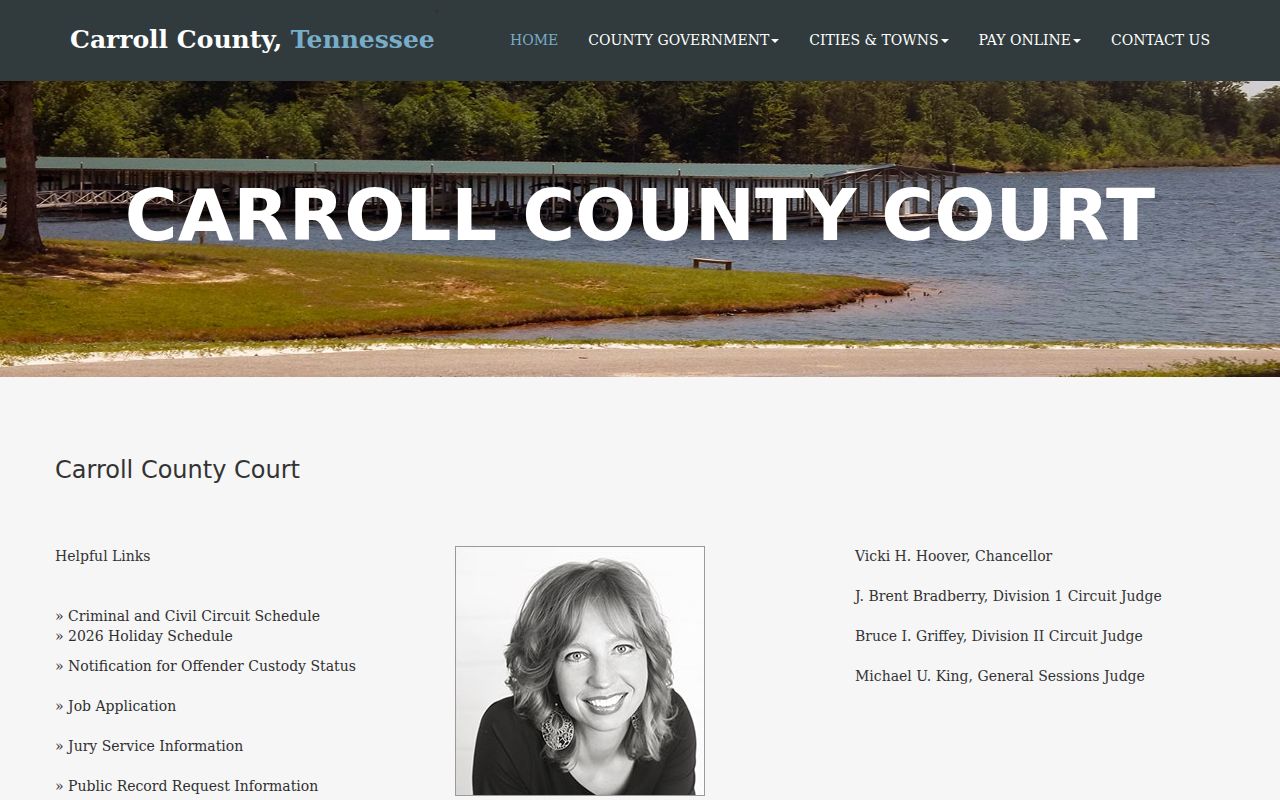
That official page is the best starting point when a search result must be followed by a call, counter visit, court calendar, or records form.
Note: An agency report and a court file describe different parts of one event and must be requested from their separate custodians.
Searching Carroll County Case Records
The county-linked LGC portal searches Circuit and General Sessions cases. It accepts a party name or old case reference, filing year, numeric case suffix, court type, and case type. A CAPTCHA is required. The system supports quoted phrases and some typo tolerance, but its search-help rules may drop terms to fill the result cap. Treat each result as a lead, then compare the case year, court, number, and charge before assuming a name match is the correct Carroll County criminal case.
- Open the Carroll Court Case Search and select either General Sessions or Circuit Court.
- Choose Criminal as the case type. Start with a complete first and last name, or use the numeric suffix from a known case number.
- Add the case year when the name returns too many rows. Keep “Match all search terms” checked for the first pass.
- Open and read the docket fields, then compare the court, charge, hearing type, events, and disposition at the count level.
- Contact the proper criminal clerk for missing material, older files, inspection, plain copies, or a certified Carroll County court record.
| Field | Type | Required | Format or use |
|---|---|---|---|
| Party Name / Case Reference | Text | No | Use a name or old reference, not both; quoted phrases and typo tolerance are supported. |
| Match all search terms | Checkbox | No | Checked by default; the system may back off terms near its result cap. |
| Case Year | Number | No | Enter the filing year to narrow the case records. |
| Case Number | Number | No | Enter only the final numeric suffix from the formatted case number. |
| Court Type | Choice | Yes | Select Circuit Court, General Sessions, or both as appropriate. |
| Case Type | Choice | Yes | Select Criminal rather than Civil. |
| CAPTCHA | Challenge | Yes | Complete it to enable “Find Now.” |
If the help system broadens a name search, use the filing year or numeric case suffix to tighten it. Confirm the match with the clerk when the public docket lacks enough identity detail.
Carroll County Portal Limits
The search portal states that it is compiled for public service and is not the official clerk's record. It gives no assurance that the display is complete, accurate, or current. That warning matters when a newly entered disposition has not appeared, a filing is absent from the public view, or an older Carroll County criminal case does not return. A literal filter on the result screen only filters displayed text. It does not perform the main search's phrase or typo logic.
Review the portal warning before relying on an online row. The Carroll case portal terms and their limits appear in the source image below.
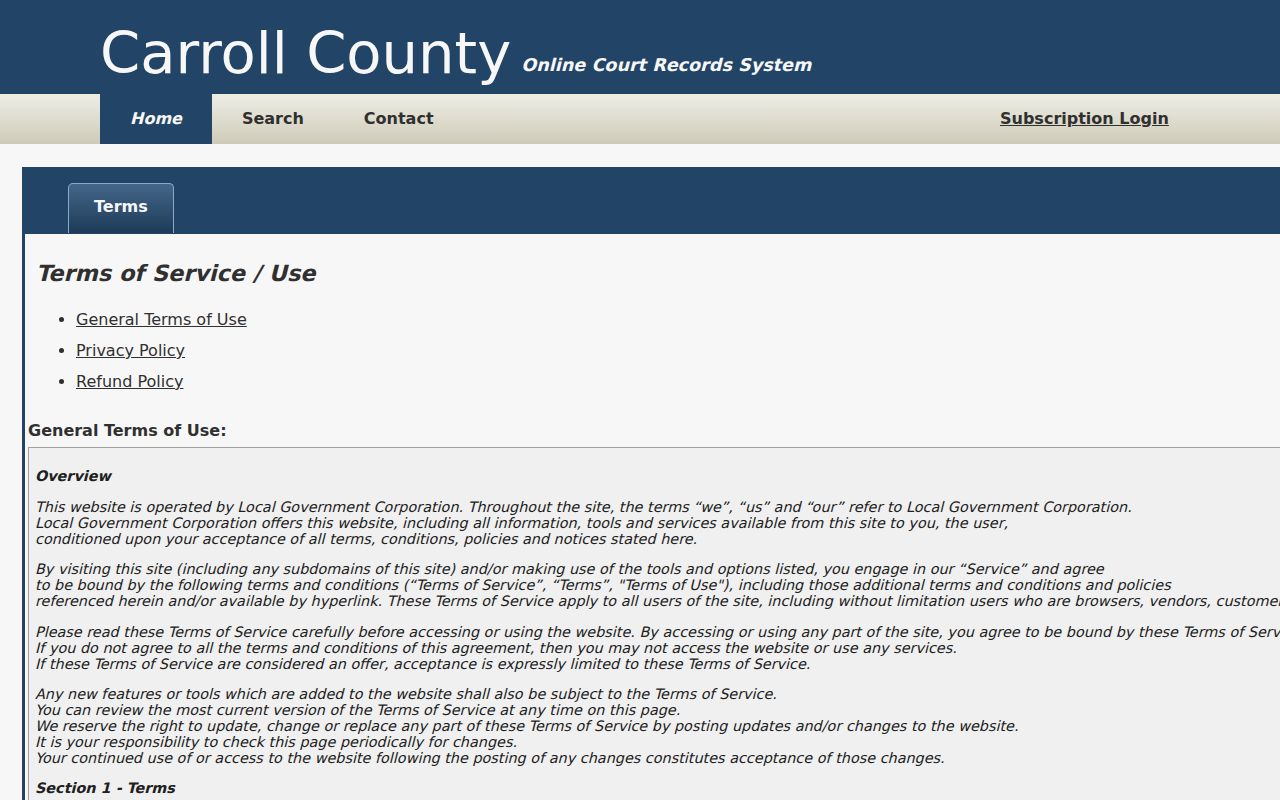
The terms support a simple rule: use the portal to find the case, then use the criminal clerk for the authoritative docket, judgment, or certification.
Inside a Carroll County Case File
A Carroll County court file records the legal path of filed charges. Published docket formats can show the office, court, case number, hearing date, judge, offense text, violation date, hearing type, attorney or officer notation, and event language. They do not stand in for every underlying document. The full file may also contain a complaint or indictment, motions, plea papers, orders, judgment, sentence terms, cost records, and warrants that the public list does not display.
| Case Number and Court | Identifies the court level, filing sequence, year, and specific Carroll County proceeding. |
|---|---|
| Charging Document | Shows the complaint, information, or indictment that formally states the allegations. |
| Docket Entries | Tracks filed papers, hearing events, bench-warrant text, and the order of court action. |
| Hearing Dates | Lists scheduled or completed appearances and the type of hearing. |
| Disposition and Judgment | States the outcome at the charge level, such as dismissal, acquittal, or conviction. |
| Sentence and Conditions | Records punishment, supervision, costs, restitution, and other terms when imposed. |
Names or charges alone do not establish an outcome. Read each count. “Nolle prosequi” means the prosecutor declined to continue that charge at that time; “no true bill” means the grand jury declined an indictment; and dismissal, acquittal, and conviction each carry a different result.
Carroll County Docket Codes
Formatted numbers such as 9GS1-2018-CR-2063 and 9CC1-2023-CR-96 point to different Carroll County court tracks. “GS” identifies a General Sessions matter, “CC” identifies Circuit Court, and “CR” marks the criminal case type. The portal asks for only the final numeric suffix in its Case Number field. Typing the entire formatted number there can keep a valid record from appearing.
Docket terms also need context. “Warrant Bench” or a failure-to-appear event can appear in the case history, but the display is not a live warrant-status database. Confirm present status with the issuing clerk and the Carroll County Sheriff's Office before acting. For a broader explanation of local warrants and related records, the Carroll County criminal history overview connects the clerk, sheriff, and state channels.
- Arraignment
- The charge is formally presented and a plea is entered.
- Disposition
- The outcome of a specific charge.
- Nolle prosequi
- The prosecutor declines to continue the charge at that time.
- Capias
- A court order directing that a person be taken into custody.
Note: A docket event can signal court action, but only the issuing office can confirm whether a warrant remains active.
How a Criminal Case Moves
A Carroll County criminal case can start with an arrest or citation and an initial appearance. General Sessions handles the complaint, bond work, and preliminary felony proceedings. A misdemeanor may end there. A felony can move through the grand jury; after an indictment, Circuit/Criminal Court handles arraignment, motions, pretrial settings, plea or trial, judgment, and sentence. An appeal then leaves the local trial-court portal for Tennessee's appellate Public Case History system.
Case flow: Charges Filed › Arraignment › Pretrial › Plea or Trial › Disposition › Sentencing
The sequence explains why one event may have two Carroll County case numbers. It also explains why an early charge listing is not a conviction. The court must reach and enter a disposition before the case file can show the final outcome.
Certified Carroll County Case Files
Inspection is available during the county's normal weekday business hours. The published court request form prices noncertified copies at $0.50 per page. Certification costs $5 for each certification and seal, plus $0.50 per page. A mailed request requires full payment by cashier's check or money order and a self-addressed stamped envelope. The form also lists pickup, email, fax, and mail as delivery preferences, though the record and payment method can affect what is available.
Describe the court record with a full case number if known, the party name, approximate year, court level, charge, or hearing date. State whether you want inspection, a plain copy, or a certified copy. The Carroll court public-record request form also explains why a request may be delayed or denied, including insufficient detail, unpaid estimated costs, or a legal confidentiality rule.
The official Carroll Circuit and General Sessions case search is shown below.
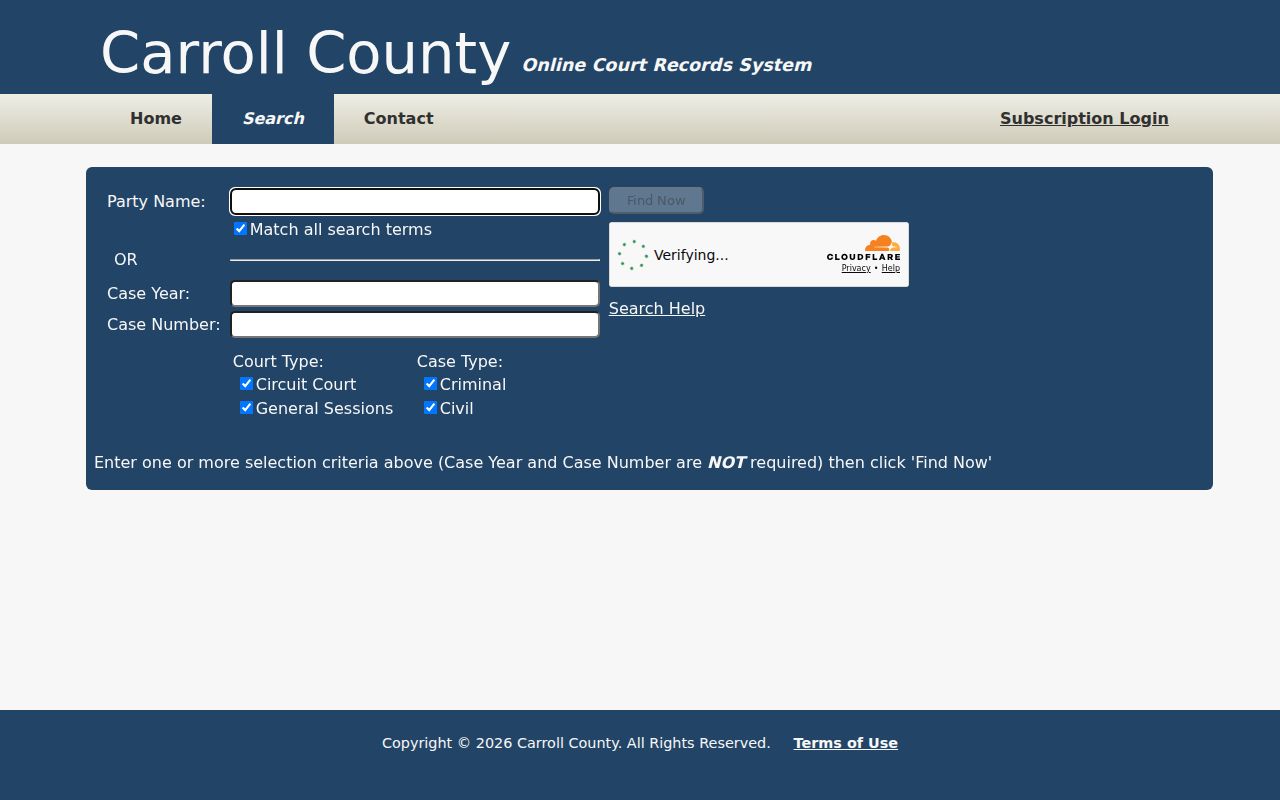
Its separate court and case-type choices help identify the right clerk before a copy or certification request is sent.
Case Record Access and Restrictions
The Tennessee Public Records Act generally opens public records to Tennessee citizens unless another law makes material confidential. Carroll County's court form asks about citizenship and requires enough detail to identify the requested file. Access does not remove protections for juvenile matters, victims, minors, Social Security numbers, account data, sealed filings, or other information made confidential by state or federal law. The clerk may redact protected data while releasing the rest.
An online omission can also have a nonconfidential cause. The record may be too old for the index, newly entered, filed under a different name or case number, or maintained only in the clerk's authoritative file. Ask the relevant criminal clerk to search before concluding that no Carroll County case exists. A request for an agency narrative, 911 audio, body-camera file, or booking record belongs with the agency that created it, not the court clerk.
Carroll Court Records Versus TORIS
The county court portal and TBI's TORIS product answer different questions. Carroll County court records show local filings, hearings, pleas, orders, dispositions, and sentences. TORIS is a paid, name-based search of fingerprint-supported Tennessee arrest cycles and linked outcomes submitted to TBI. It omits aliases and is not fingerprint proof for the ordinary public search. Neither product replaces the other.
Use the clerk when the goal is a pleading, judgment, disposition, sentence, or certified Carroll County court document. Use TORIS when reviewing the statewide Tennessee repository record. When the two differ, confirm the local judgment first and follow TBI's dispute route if the statewide result appears to belong to someone else or lacks a reported outcome.
Note: A court disposition may appear before TBI can link it to the matching fingerprint-supported arrest cycle.